Research
An overview of Stefan Breet's research, including publications and academic talks on entrepreneurship and innovation.
Research areas
I explore how an employee's position in organizational networks enables or constrains the generation and implementation of creative and innovative ideas.
Publications & talksI study how organizations, teams and employees can become more entrepreneurial and innovative.
Publications & talksI develop and apply NCA, a statistical methodology for identifying necessary conditions in social science research, with a focus on strategy and entrepreneurship.
Publications & workshopsPublications
View all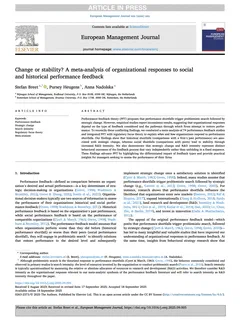
Change or stability? A meta-analysis of organizational responses to social and historical performance feedback
Stefan Breet, Pursey Heugens, & Anna Nadolska
European Management Journal · Journal Article · 2025
The power of alignment: Conceptualizing strategy-identity alignment in Dutch energy companies
Stephanie Koornneef & Stefan Breet
Organizing the Dutch Energy Transition · Book Chapter · 2024
Understanding the Perks and Pitfalls of Cross-legacy Boundary Spanning
Stefan Breet & Lotte Glaser
Advances in Mergers and Acquisitions · Book Chapter · 2022

A Network Perspective on Corporate Entrepreneurship
Stefan Breet
Erasmus University Rotterdam · Dissertation · 2022
Talks
View all
Ode to the Bouncer: Music Festivals as Dynamic Gatekeepers of Radical Innovation
An event-centered perspective on radical innovation in the creative industries, using music festivals as dynamic selection systems.
Tilburg University · May 26, 2026

Necessary Conditions for Team Creativity: Composition and Competence
This study investigates the necessary conditions for team creativity, focusing on team size, team network, and team members’ expertise in the context of R&D.
ANZAM Conference · December 5, 2024

Bottleneck or Not? The Ceiling Effect of Network Closure on Individual Innovative Performance
A presentation of a study showing that closed networks serve as social straitjackets that prevent employees from achieving high levels of innovative performance.
ANZAM Conference · December 4, 2024

The Double-Edged Sword of Post-Merger Organizational Identification: How Social Ties Influence Employee Initiative Taking
This study shows that organizational identification in M&As can help or hinder employee proactivity, depending on social ties within merging firms.
The University of Sydney · November 7, 2024

Bottleneck or Not? The Ceiling Effect of Network Closure on Individual Innovative Performance
A presentation of a study showing that closed networks serve as social straitjackets that prevent employees from achieving high levels of innovative performance.
Academy of Management Annual Meeting · August 12, 2024